
Editor’s Note:
In 2025, we visited more than 20 leading retailers and confectionery brands across the United States. Candy is one of the most universal consumer categories in the U.S. Yet among the shelves we visited, Amos was the only Chinese sugar confectionery brand we consistently saw in mainstream retail channels.
The following content reflects our thinking behind the investment in Amos.
When we shared our investment thesis on Softcare, we emphasized that BA Capital’s perspective has never been limited to “going overseas.” We look for companies with the capability to build multinational businesses and, ultimately, global brands.
As a hidden champion in consumer goods manufacturing across emerging markets, Softcare overcame Africa's extremely fragmented operational landscape through a model integrating deep distribution networks with direct terminal access and localized production.
Similarly, Amos offers another version of this globalization story. Its growth demonstrates how emerging consumer brands can compete in mature global markets through product innovation, category definition and localized retail execution.
Founded in 2004, Amos Food Group owns the confectionery brand Amos and the nutrition-focused confectionery brand Biobor, with sales coverage extending to over 80 countries and regions, including China, the United States, Australia, Europe, and Southeast Asia.
The difference in globalization trajectories between the two companies extends beyond the distinction between emerging and developed markets. Softcare has achieved a "locally produced and sold" model in a largely untapped yet operationally demanding market, delivering products with strong value-for-money to local consumers.
Amos, by contrast, has demonstrated that — even within a competitive market fortified by industry giants and entrenched brand moats.
On April 28th, Amos submitted its listing application to the Hong Kong Stock Exchange (HKEX). As a result of its "Happy + Healthy" product strategy, Amos's revenue increased from RMB 1.070 billion in 2023 to RMB 2.782 billion in 2025, representing a CAGR of 61.2%. Net profit increased from RMB 137 million in 2023 to RMB 600 million in 2025, with net profit margin expanding from 12.8% to 21.6%.
- By retail sales value in 2025, Amos is the largest Chinese sugar confectionery company and the fifth-largest gummy company globally.
- By retail sales value from 2023 to 2025, Amos is the fastest-growing company among the world's top 30 sugar confectionery companies, with a CAGR of 61.9%, compared to the industry average of 5.9% over the same period.
- By overseas revenue in 2025, Amos commands the largest overseas market share among all Chinese confectionery companies.
True globalization means localizing in every market— including the localization of product, operations, and organizational capabilities.
A Creative Candy Brand Breaks Into the American Candy Hall of Fame
The U.S. confectionery market is dominated by companies such as Ferrero, Mars Wrigley, The Hershey Company, Mondelēz International, and Perfetti Van Melle — each of the dominant players is a century-old institution, carrying 80 to 130 years of heritage. They have built formidable brand moats across generations, following a trajectory from family-owned workshops, signature products, strategic distribution, to global expansion through M&A.
Breaking into such a mature and concentrated market is extremely difficult — yet Amos has done it.
Since its inaugural inclusion in 2023, Amos has ranked among the Global Top 100 Candy Companies for the fourth consecutive year in 2026, and has now advanced into the top 50.
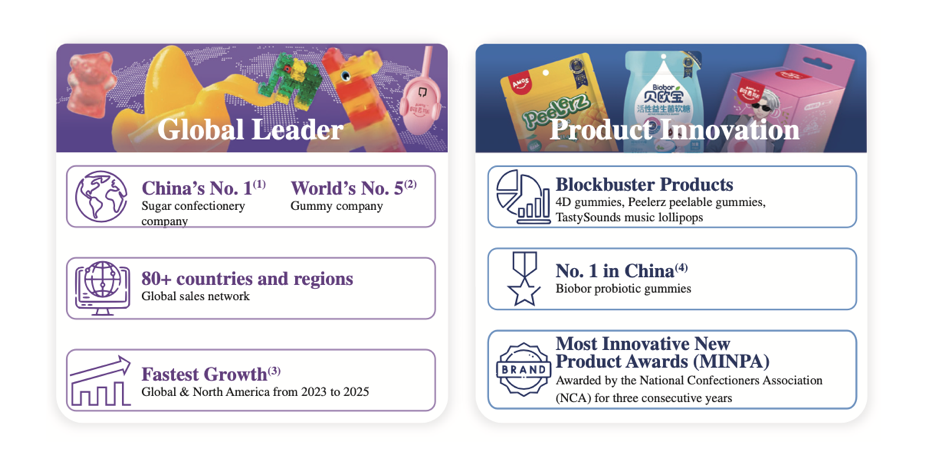 Figure: Amos's industry leadership position. Source: Prospectus
Even in the United States — the world's most competitive confectionery market — Amos has successfully entered mainstream retail channels including Walmart, Target, and Costco.
This product innovation-led breakthrough also brought wider industry recognition. In 2024, Amos founder Ma Enduo, also known as Amos Ma, was inducted into the Candy Hall of Fame, becoming the first Chinese entrepreneur ever to receive the honor.
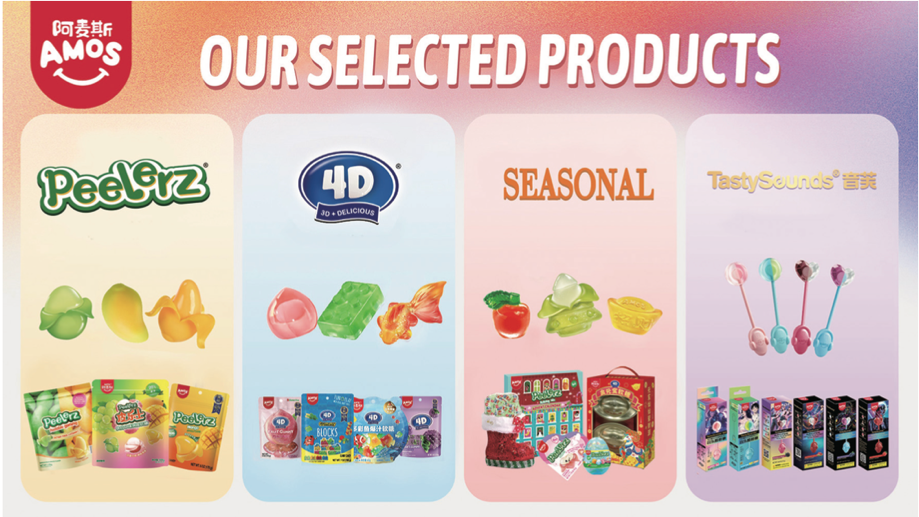 Figure: Selected Amos product portfolio. Source: Prospectus
Product Innovation: The First Step Toward Brand Mindshare
In confectionery, we believe that it is important to build the perceptual brand moat, which requires coordination across two dimensions:
Product Innovation: the ability to create hero SKUs with strong consumer pull and category-defining potential; Channel Execution: the ability to penetrate core retail channels efficiently and capture shelf share.
Within this framework, product innovation is the starting point. Superior product-definition— and more importantly, category-definition— is not only the key prerequisite for gaining access to mainstream channels, but also the fundamental driver for breaking through and earning consumer loyalty in mature markets.
- Gummies Are the Fastest-Growing Confectionery Subcategory
According to Frost & Sullivan, in terms of retail sales value, the global sugar confectionery market size increased from approximately RMB 1,228.8 billion in 2021 to approximately RMB 1,533.0 billion in 2025. Within this market, the sugar confectionery and chocolate segments reached RMB 538.1 billion and RMB 994.9 billion in 2025, respectively, representing CAGRs of 6.7% and 5.2% from 2021 to 2025.
The growth of the chocolate market during the historical period was primarily driven by the recovery of offline festive consumption scenarios, the structural upgrade of high-end products, and the continuous penetration of distribution channels in emerging markets. Looking ahead, as the growth space in mature markets narrows, the overall growth trend of the chocolate market is expected to moderate, creating an urgent need for innovative products and brands to drive expansion.
In contrast, sugar confectionery has outpaced chocolate in terms of growth rate. This outperformance is primarily driven by greater product innovation, which enables sugar confectionery to meet global consumers’ demands for novel product formats and healthier ingredients, with gummies serving as the core growth engine.
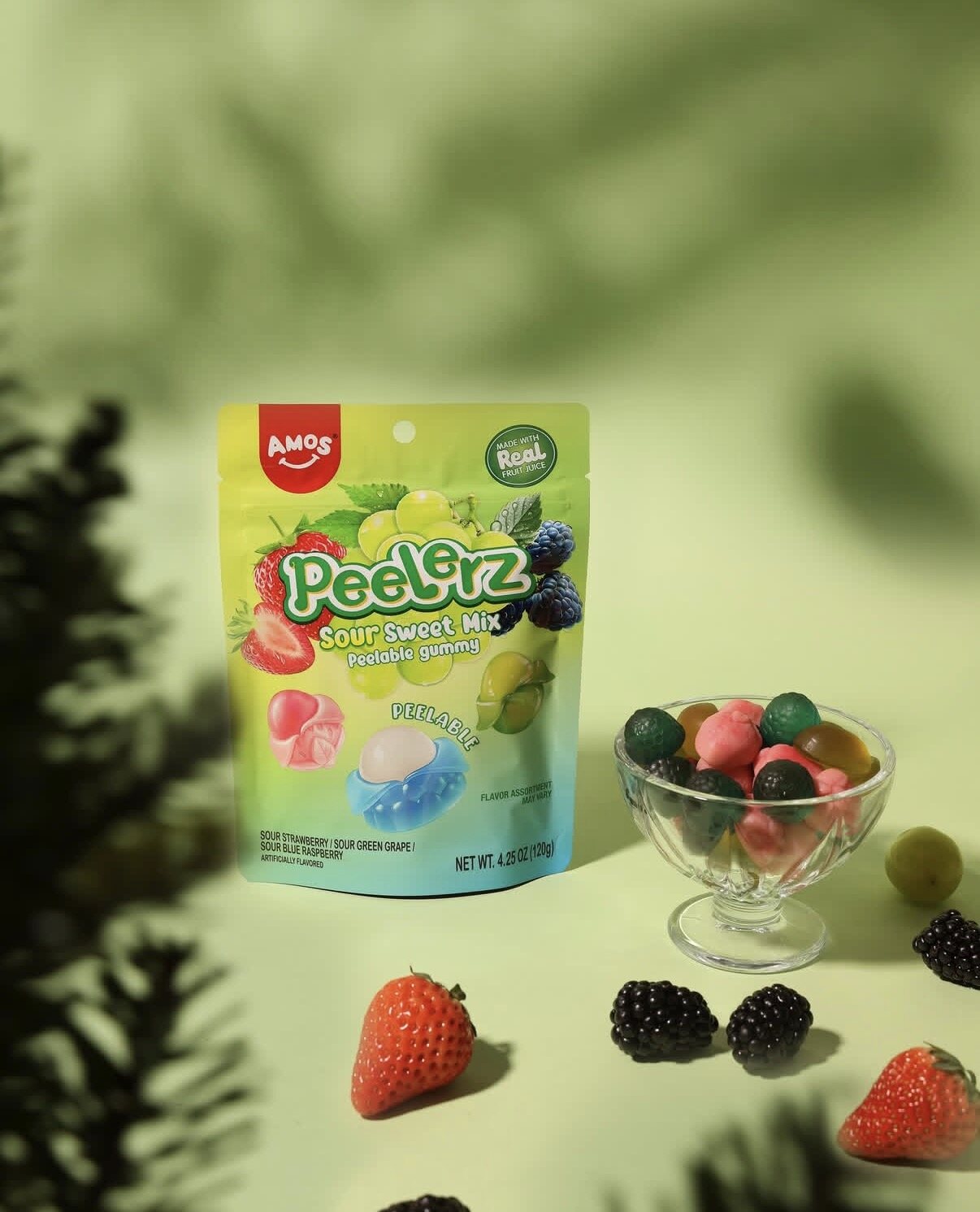
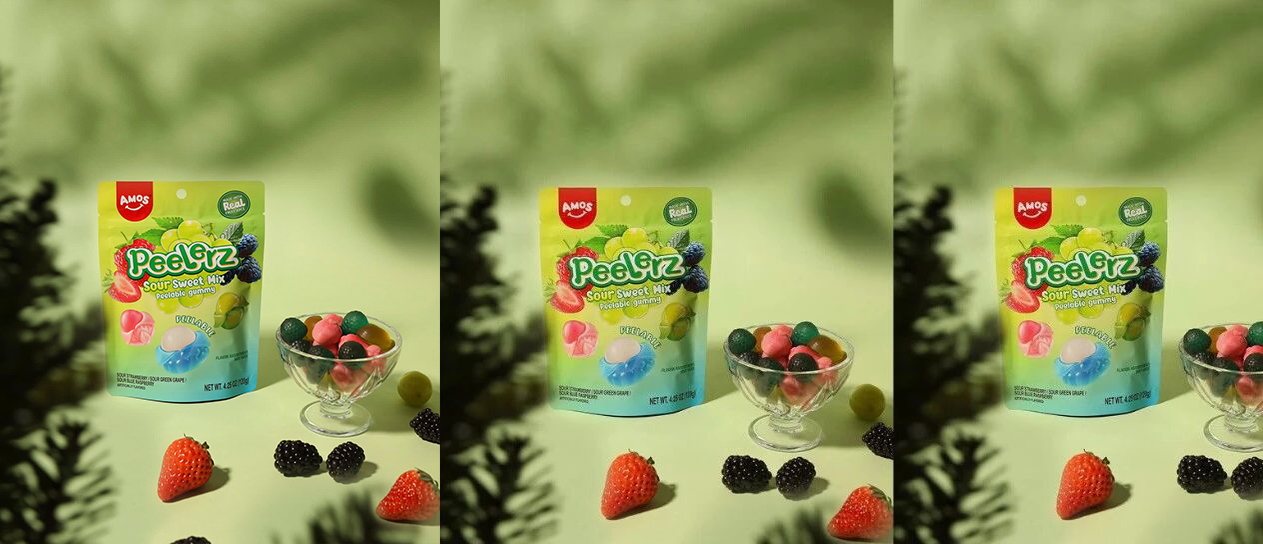
In 2023, Amos launched Peelerz, its signature series, entering the fastest-growing segment of the gummy category.
Competition remains intense, particularly as leading global players continue to strengthen their brand portfolios, product innovation capabilities, and distribution networks. The gummy segment is relatively concentrated, with the top five companies accounting for 58.8% of the global market in 2025.
- Product Innovation as the Core Growth Driver
According to Frost & Sullivan, the global gummy market reached approximately RMB 242.1 billion in 2025, making it one of the key subcategories within sugar confectionery.
The faster growth of the gummy segment stems from its precise alignment with the core development trends of the global confectionery industry. Among diverse sugar confectionery segments, gummies’ differentiated competitive advantages enable it to contain in-depth coverage of all consumer groups and scenarios.
- Historical Success Pattern: Product Innovation as a Growth Catalyst
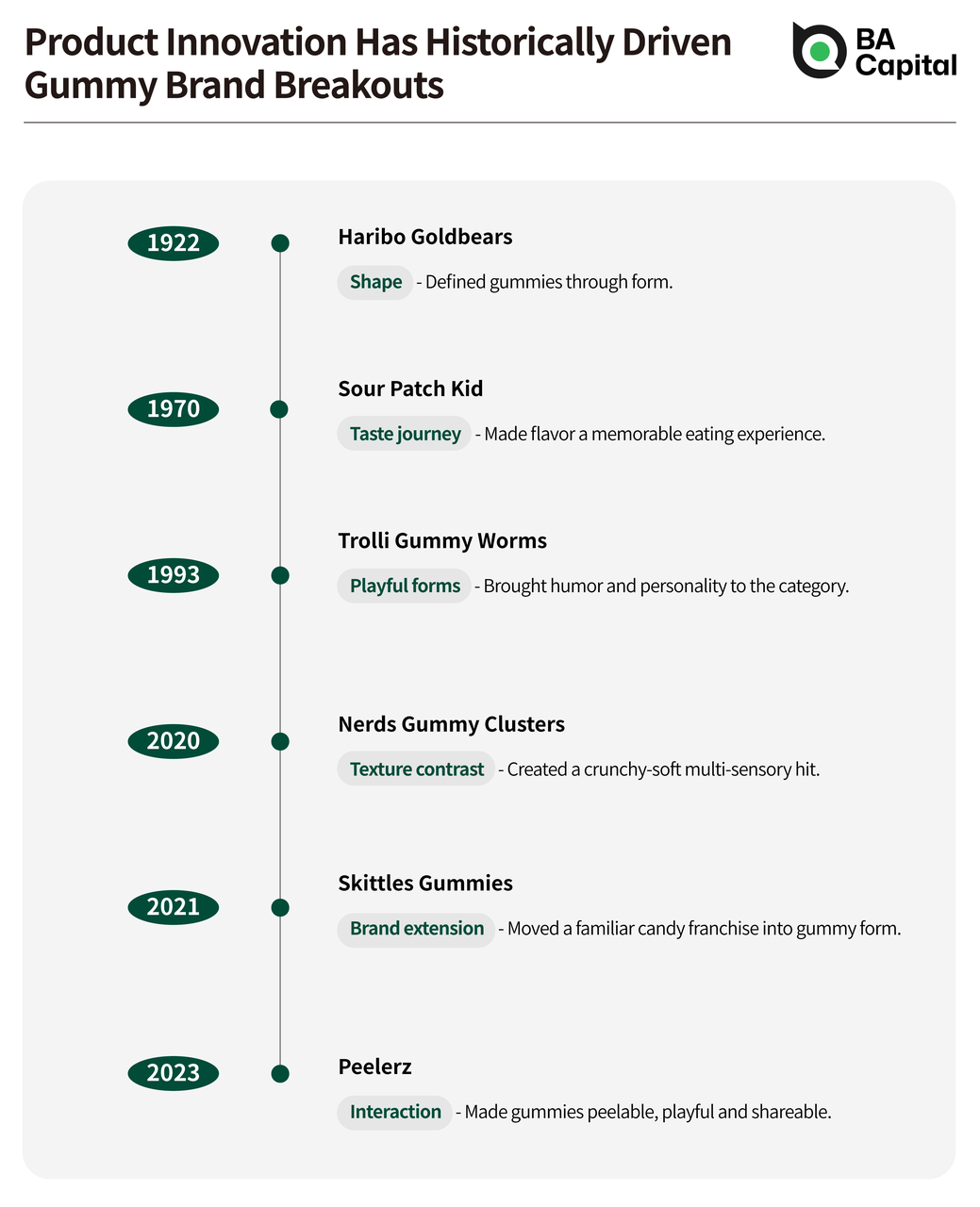
Across the history of leading U.S. gummy brands, step-change growth has often started with genuine product innovation.
Format and formulation innovation (1922–1993): Haribo’s bear-shaped gummies helped define the category. Sour Patch created a distinctive taste journey through its “sour then sweet” profile. Trolli brought playful and unconventional shapes to the market. These innovations moved candy from functional satisfaction toward emotional and experiential consumption.
Structural and experiential iteration (2020–2024): As the category became more mature, innovation became more granular. Nerds Gummy Clusters, launched in 2020, became one of the most notable growth cases in recent years. Without a large-scale advertising warm-up, the product generated strong word of mouth through its crunchy-outside, soft-inside multi-sensory experience. Sales increased 20-fold compared with the time of Ferrero’s acquisition.
Amos follows the same logic of product-led virality. Its original 4D building-block gummies and juice-filled fruit gummies, launched in 2015, became benchmarks for gummy innovation and gained strong traction among younger consumers. Amos Peelerz Mango, launched in 2023, took this further by combining the realistic experience of peeling fruit with strong social-sharing attributes. Since launch, Peelerz and other peelable fruit gummies have received broad attention, especially among younger consumers.
- Channel Feedback: Category Definition in Action
Our research across U.S. retail channels showed that product innovation is one of the most important factors behind retailers’ product selection and continued support. This is especially true in growth categories such as gummies. A brand’s ability to keep launching new products and flavors directly affects retailers’ expectations for sales performance and their willingness to allocate shelf resources.
Through in-depth conversations with senior teams at mainstream U.S. retailers, we saw how Amos has used product innovation to achieve category definition.
Retailers told us that consumers increasingly see Peelerz as something distinct from traditional gummies. Its texture sits between a fruit roll-up and a conventional gummy, while its differentiated shelf presentation gives it natural visual standout.
More importantly, Peelerz is not only delivering short-term sales momentum. It is beginning to build consumer mindshare. Compared with mature global brands, retailer feedback suggests that Amos’s repeat-purchase performance is moving closer to that of evergreen North American brands.
- Consumer Trends: Functional Needs and Emotional Value
The analysis above reflects historical category evolution and current channel feedback. But the deeper reason product innovation works is that it captures changing consumer needs more accurately.
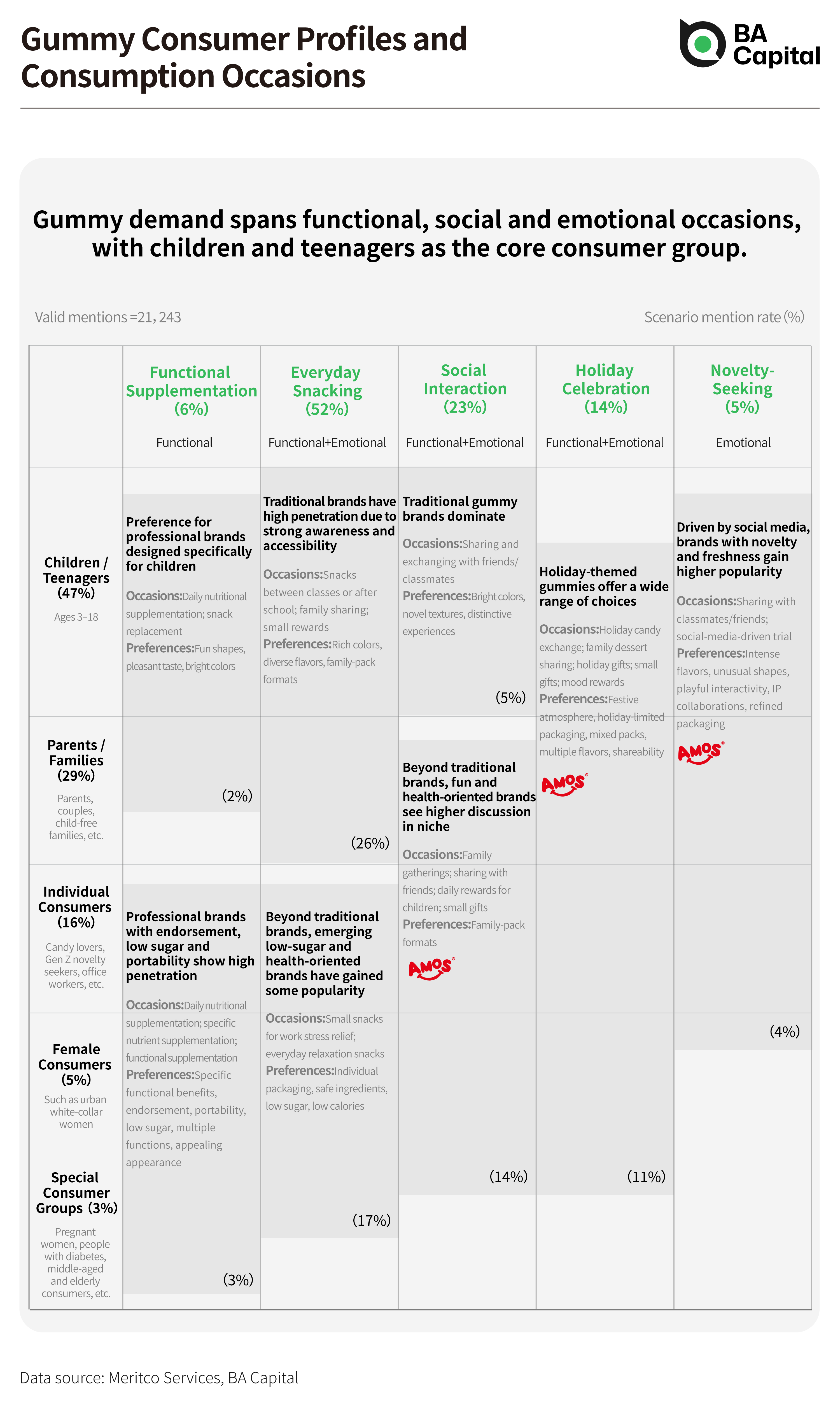
Based on our analysis of U.S. consumer opinions, gummies meet a wide range of functional and emotional needs. Their use cases form a clear hierarchy.
Everyday occasions: Daily snacking — including school-break, after-school, and at-home sharing — where traditional brands dominate these occasions through high awareness and broad distribution.
Interactive occasions: Driven by social interaction, holiday and seasonal celebrations, and novelty-seeking behavior. In these contexts, consumers care more about playfulness, talkability, and shareability.
Supplement occasions: Focused on children's nutritional supplementation or specialized functional use cases for specific consumer groups.
When looking at purchase motivations, taste and flavor commands a significant lead (60% mention rate) as the most important drivers; product quality and healthiness (13%), visual appearance and packaging (11%), and novelty and entertainment value (9%) also carry meaningful influence; price (5%) and channel convenience (2%) register lower in the decision-making hierarchy.
Through analysis of over 20,000 consumer reviews, we found that U.S. consumers are no longer buying gummies simply for sweetness. They are increasingly looking for products with richer sensory layers, more natural and healthier attributes, and a stronger emotional premium.
- Innovation Across Format, Flavor and Texture
Amos Peelerz represents a meaningful and strategic innovation in the gummy category in recent years because it innovates across three dimensions at once: format, flavor, and texture.
In format, Peelerz turns the act of eating candy into an interactive experience. The realistic peeling motion makes the product visual, playful and shareable — a strong fit for social occasions.
In flavor, Amos did not keep the conventional mixed-fruit flavor route. Instead, it used mango as the signature flavor. Among gummy SKUs sold by leading retailers in the U.S., sour flavors account for nearly half of sales. Mango’s naturally sweet-and-sour profile fits this preference well, while other brands have had relatively limited offerings in mango flavor.
In texture, Peelerz differentiates the outer peel and inner through its production process. Many consumers describe the fruit-puree-like center as “like eating real fruit.” This experience breaks the traditional stereotype of candy and supports repeat purchases.
- Gummies as the Ideal Medium for Health and Experience Upgrades
Gummies are structurally well-suited for product upgrades. Their gel-forming process allows brands to use technologies such as precise temperature-controlled gelling and 3D printing to create elastic, chewy, popping, filled, and flowing-core textures, which fundamentally breaks the crisp-and-hard texture constraint of traditional hard candy.
Gummies can also be made into playful, occasion-based, and customized shapes. This allows the category to satisfy both sensory and novelty-seeking needs while better aligning with younger and more personalized consumer trends across global markets.
From a formulation perspective, gummies also have clear advantages. Compared with the high-temperature boiling process used for traditional hard candy, the low-temperature gel-forming process used in gummies can better preserve ingredients such as probiotics, vitamins and plant extracts. Gummies are also more adaptable to low-sugar or sugar-free formulas, natural ingredients, and plant-based gelling systems. This gives the category stronger potential in nutrition confectionery and creates product competitiveness that is difficult for hard candy to replicate.
Among Amos’s products, 4D (“3D + Delicious”) Blocks Gummies created a new category by introducing buildable block gummies as well as fruit- and animal-shaped products.
Distribution Efficiency: From Product Mindshare to Brand Mindshare
Product innovation allowed Amos to capture consumer demand for richer sensory experiences, social fun and healthier products. Through format, flavor and texture innovation, the company successfully launched star products such as Peelerz.
With differentiated naming, first-mover positioning and a clear product experience, Peelerz has created a strong association between the Amos brand and the emerging “peelable gummy” category. This is the beginning of product mindshare. But product mindshare alone is not enough. To build sustainable brand mindshare, two conditions are required:
First, the category must have enough growth headroom to support long-term brand investment.
Second, in confectionery, broad shelf visibility is essential as consumers often make purchase decisions right in front of the shelf.
For gummies, physical availability still drives real sales conversion and market share. Online platforms can help seed awareness and create social virality, but offline distribution remains the core battlefield. At its commercial core, confectionery is still a competition over distribution efficiency and depth of reach.
- Gummies Are a Major Growth Category in Confectionery Markets
According to Frost & Sullivan, the global gummy market is projected to reach RMB 400.9 billion by 2030, representing a 2025–2030 CAGR of 10.6%. By comparison, the hard candy market is expected to grow at only 0.4% CAGR over the same period. This contrast suggests that gummies are one of the formats with stronger growth potential and greater room for product-led differentiation.
In developed confectionery markets, this growth potential is supported by an already substantial consumption base. According to the same source, the sugar confectionery market reached RMB 141.5 billion in North America and RMB 157.8 billion in Europe in 2025, and is expected to reach RMB 185.5 billion and RMB 202.9 billion by 2030, respectively.
- A Category Where Shelf Presence Drives Brand Memory
In mature confectionery markets such as North America and Europe, gummies already benefit from broad consumer familiarity and established retail shelf space. The challenge for new products is therefore not basic category education, but whether they can create a differentiated reason to choose — and then remain visible long enough to build repeat purchase.
For impulse-driven products such as gummies, online attention can spark curiosity, but offline retail still drives much of the conversion. Shelf visibility, availability and sell-through are what turn product novelty into brand relevance.
- Deep Penetration and Share of Core Channels
More than half of Amos’s revenue comes from North America.
Amos has accumulated more than 20 years of global channel experience. Today, the company has entered mainstream retail channels in North America and extended its distribution network to smaller end-market stores. This allows innovative products to reach consumers quickly and repeatedly. Highly frequent visibility is critical. It helps convert first-mover product association into actual consumer mindshare.
- Channel Penetration and Mindshare Retention
In the highly competitive U.S. confectionery market, "getting in" is merely the first step — "staying in" is where the real competitive moat is forged.
For the confectionery industry, shelf space is a scarce resource. If a product only reaches the shelf through proactive channel push but fails to build consumers’ perception, its presence is likely to be short-lived. In the mature U.S. retail system, new products face a brutal elimination process. If they cannot turn into stable sell-through within six months to one year, 80% or even 98% of products may disappear from shelves.
Innovation Is Not a One-Time Capability
Flagship Product and shelf share can accelerate brand mindshare. But when competing against global groups with extensive brand portfolios and operating systems, continuous innovation matters even more.
Amos’s core strength is not only that it created a breakout product such as Peelerz. More importantly, it has built a replicable innovation system. Supported by mature supply-chain capabilities, the company can translate ideas into products — and products into shelf presence — with speed and consistency.
- Systematic Global Innovation
Amos has built an end-to-end operating system that connects R&D, production, channels and brand building. The system is anchored in global consumer insights and market trends, and supported by disciplined execution across the full value chain.
Through its dual-brand strategy, Amos reinforces the mindshare of “happiness + health” while continuing to advance category innovation. The result is an efficient and scalable path from “idea to shelf.”
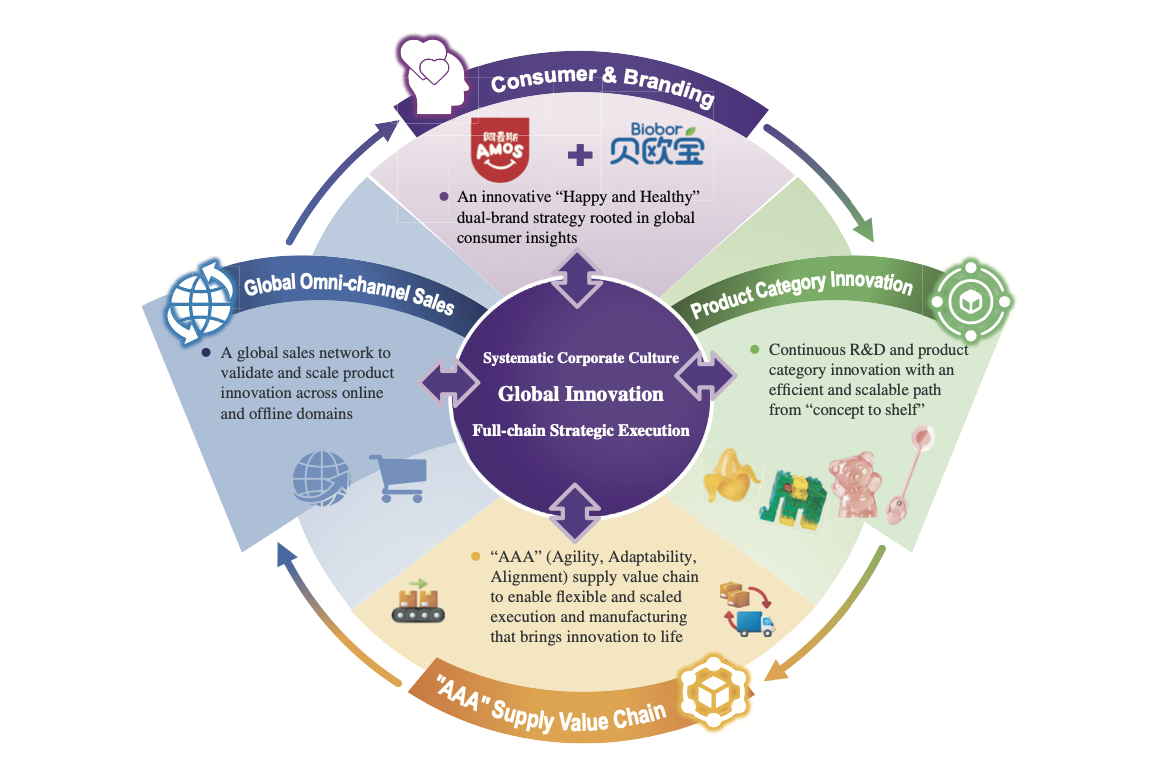 Figure: Amos’s business model. Source: Prospectus
- Supply-Chain Flexibility and Automated Production
Amos has a manufacturing base capable of supporting global supply. Its production base in Jiangmen, Guangdong, is the largest confectionery production center in China. The facility has a gross floor area of more than 110,000 square meters, involved total investment of several hundred million RMB, and introduced advanced international confectionery production-line equipment.
This scaled and automated production capability allows Amos to respond quickly to demand for product-level micro-innovation, including changes in flavor, specification and packaging. At the same time, the company is optimizing its global production layout and using localized production to better manage international trade volatility.
- Institutionalized Innovation and Reusable Channel Assets
Amos has developed a mature innovation cadence. Each year, it continues to launch new formats, play patterns and seasonal products, including Halloween collections. From holiday candies to 4D gummies and now Peelerz, Amos has shown that innovation is embedded in the organization rather than dependent on a single product cycle.
Its channel assets are also highly reusable. Once a new product proves strong enough, Amos can leverage existing retail relationships and distribution infrastructure to scale it more efficiently.
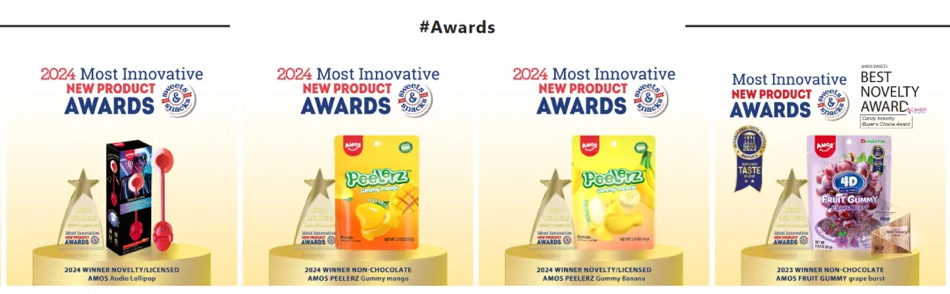 Figure: Selected Amos products and awards.
Closing
In the Candy Hall of Fame induction speech, founder Amos Ma shared the story behind Amos. When he was a child, his family was poor. One day, his father asked him to give a coin and a piece of candy to a beggar at their door. He never forgot that moment. Years later, he founded Amos with the mission of becoming “the sweet messenger of the world”.
Amos began as an OEM export business, initially serving emerging markets before graduating to developed ones. It then built its own brands, re-established its presence in China, and eventually became a category leader with localized marketing capabilities across global markets.
According to the founder, the company receives letters from consumers around the world every year. One letter arrived from America — written by a 21-year-old cancer patient expressing deep gratitude: during the chemotherapy, Peelerz gummies had given him strength and comfort. This is the starting point of Amos. A truly global brand is not defined only by innovation and channel reach. It also requires the capacity to carry a global mission and vision.
It is this sense of mission that has taken Amos from China to the world — and continues to drive the company forward: bringing happiness and health to consumers worldwide through candy, while sharing the spirit of love, joy, and social good to every corner of the world.